
Unlikely Hero
Everyday Courage, Cue the Fanfare!

I didn’t set out to write Unlikely Hero. In fact, I was working on a completely different song — one with lyrics, headed toward a contemporary pop style. Then something happened that’s fairly common for me: the music took over, changed direction, and became something else entirely. What emerged felt truer to my style — an instrumental that lets the music speak for itself.
Below I walk through the piece with some harmonic analysis and commentary. Although my knowledge of traditional functional harmony is ingrained, I do follow my ear and let it take me wherever it goes when I’m composing.
But I then have to go back and understand the path I took, and why it works (or didn’t) so I can hopefully cement these recipes in my mind for future compositions.
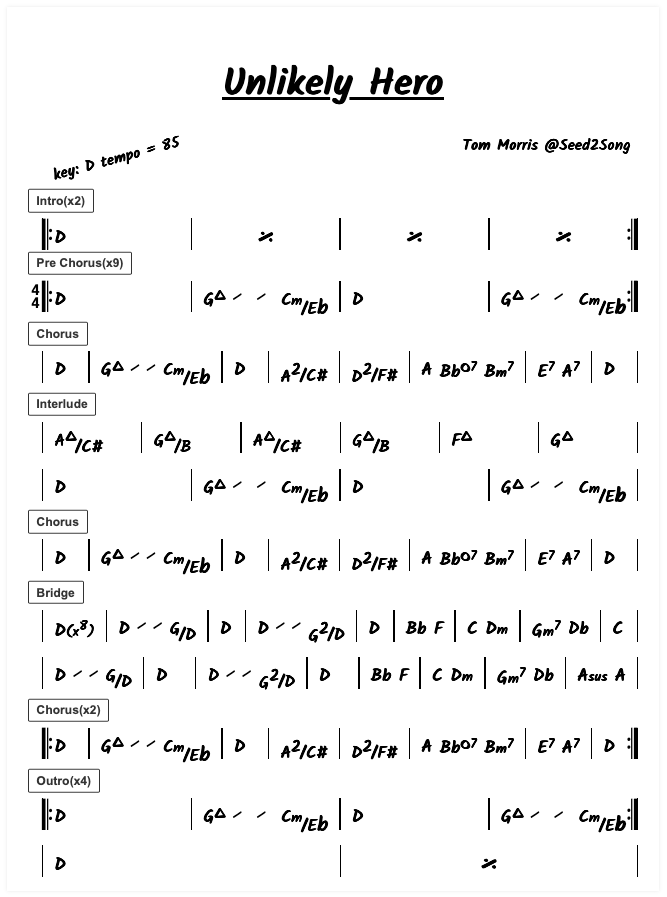
It all began with two chords: D to G major 7. I kept playing them, back and forth, letting them swell and recede, in syncopated groups of 3 as shown below. Something about that motion felt right, but incomplete.
I kept hearing a missing chord but couldn’t match it on the keys, likely because it wasn’t diatonic to the key of D.
Eventually, I found it: a C minor chord over an E♭ bass. It had a falling, sliding quality that served as a stepping stone before landing back at the tonic —and it fit so naturally that I knew it was the right passing chord that I was hearing in my head.

Composer’s Note
This Cmin/E♭ functions like a quasi–Neapolitan chord (♭II in relation to D) or could be interpreted as a tritone sub for the dominant A7 — though played without the ♭7.
That piano-led progression — D → Gmaj7 → Cmin/E♭ — became the backbone of the piece, an ostinato-like chord progression that persists almost the entire way through.
Orchestral Warm-up & Entry
The piece begins as if the listener is walking into a live performance of an orchestra during pre-game warm-up and tuning. From my early theater background, I love the concept of the willing suspension of disbelief as applied to music.
The orchestra is warming up in a free, unmetered way until the first sign of structure emerges: the delicate chime of a triangle, tapping on the quarter notes.
A subtle marimba pulse enters next, not yet playing its later right–left–left figure, just keeping a gentle heartbeat underneath.
Sweeping harp arpeggios follow, and then the tenor trombone enters with a short, cinematic motif — the kind of phrase you might expect in a John Williams score (see below) — followed by timpani rolls announcing that the meandering warm-up is over and something intentional is beginning.

Pre-Chorus — The Element of Surprise
The pre-chorus starts on the and of four — a half beat earlier than expected — giving it a subtle element of surprise that catches the listener’s attention. If you were tapping your toes during the intro, you’ll quickly realize the ground shifted under your feet a bit.
Here, the D → G → Cmin/E♭ progression takes center stage. A marimba plays a right–left–left sticking pattern, creating a gentle three-against-four rhythmic color under the piano. Trombones and saxophones begin layering in over the groove, growing in intensity.
Uncharacteristic of a traditional orchestra, the drums enter early, right after the first trombone lays down the opening melodic line. If you say to yourself “hmmm, that’s different!” that’s what I was going for. Some ear candy to keep the listener engaged.
Chorus — Full Ensemble Lift
When the chorus arrives, horns and saxes join in full force over the ostinato-like piano progression with the drums in full force. For the first time, however, the progression adapts to the lead melody of the sax — which hits a blue note (♭iii) for a soulful touch at its climax— and incorporates diminished passing chords and a secondary dominant for extra harmonic lift. See full chord chart below.
Interlude — A Breath of Fresh Air
The interlude is an unusual six-bar sequence where the strings make their first real bonafide entrance, including the contrabass dialing in the low tones. It stays in D major but breaks from the main ostinato:
A → G → A → G → F (natural) → G → D
The piano is voiced in add-2 / drop-2 shapes (A/C♯ for A, G/B for G, etc.), creating a smooth, open texture, where the contrabasses provide the grounding with the root notes.
The section hits a musical deep breath at the ♭iii (F natural chord) before returning to the tonic. I think it feels so cinematic and fulfilling because of its chromatic mediant interval from the tonic.
To maintain continuity, the trombone continues its pattern started all the way back in the pre-chorus, with the exception of a few note changes to align with the interlude chord progression.

After this comes a brief pause although the anticipation rises with the klaxon sound of tonic octaves from the piano. The trombone softly reprises the John Williams-like motif (heard only in the intro, here, and the outro). The harp, marimba, and triangle return as if winding down… and then, without warning, the full chorus bursts back in right after a classic cymbal crash choke.
Bridge — Everyday Courage, in Sound
The bridge is where the hero gets down to business. The sound of the driving percussion colored by the triangle and harp give you the sense that something heroic is in the air.
The bridge begins in D major but quickly shifts into modal mixture, borrowing from D minor — more precisely, D Dorian. In a sense, it’s almost a call and response between D major and D minor.
First 8 bars:
D → B♭ → F → C → Dm → Gm7 → D♭ → C
Second 8 bars:
Same sequence, but the final C is replaced with Asus → A.
Composer’s Note
The B♭ and C are classic Dorian colors, with the C functioning like a dominant back to D minor. The D♭, much like the Cmin/E♭ in the opening, acts as a chromatic slide down (D♭ → C).On the second 8 bars, the Asus → A functions as the dominant, leading back to the D tonic. The sus chord helps to smooth the transition from Db to A.
While the harmonic movement is intriguing on its own, the bridge’s impact comes from the rhythm: driving drums give it urgency and a cinematic sweep.
Brass counter-melodies weave around the piano’s chords, with trumpets and trombone in dialogue, building to a trumpet duet climax with runs to match the chord structure above. This, all leading to another chorus but this time with a “band drop” with drums only on 2 and 4 — setting up the final full-force refrain.
Outro — Returning to Where We Started
The final chorus gives way to the outro, where the motif returns for its last appearance. The marimba resumes its right–left–left pulse, joined by harp and triangle, mirroring the textures of the introduction.
The piece closes with the same D → G → Cmin/E♭ slide heard at the start — a gentle return to the tonic, like exhaling.
Why the Name Unlikely Hero
The title didn’t arrive until the piece was complete. I initially considered naming it after something in New Orleans — the horns and percussion gave me a Dixieland, Bourbon Street association, albeit no tuba or clarinet. But the orchestral scale, cinematic turns, and bridge fanfare pointed to a different kind of story.
I began picturing an everyday person — someone you’d never expect to see as the hero in everyday life or in a film, stepping into a moment that requires courage, and they act out of sheer instinct. Not a spotlighted figure, but someone whose quiet actions change the outcome and have deep impact on those in witness.
For me, Everyday Courage is about those small, unglamorous acts of bravery that often go unnoticed, the kind that don’t come with medals or speeches. It might be helping a neighbor in a moment of need, speaking up when it’s uncomfortable, or simply carrying on through difficult days. These moments rarely feel cinematic in real life.
Cue the Fanfare is my way of flipping that perspective. In this piece, the music treats that quiet courage as if it were a pivotal scene in a film — full brass, driving rhythms, triumphant colors. It’s my way of saying those moments matter, and they deserve to be celebrated with the same energy we’d give to any on-screen hero.
That’s how the piece feels to me: it begins humbly, with warm-ups and quiet pulses; courage grows in the bridge, driven by drums, reeds and brass; and in the end, it returns to modesty, closing with the same textures that opened it.
Like an unlikely hero stepping back into the crowd.
I love this….!! Definitely a lot of surprises throughout the piece! Unlikely hero indeed - strings to drums to horns - cadences and stances. So cool!!
very cool. appreciate the detailed breakdown.